

The useful question is: which part of a trader's work should AI take off your plate? The answer is the part that eats your time and attention. That means reading the news, tracking releases, measuring positioning and keeping a consistent framework. That leaves you free for the part only you can do: deciding whether to trade, and how much to risk.
This guide covers what AI does well, what it doesn't, four concrete ways traders use it today, and a simple daily routine.
What AI is good at in trading (and what it isn't)#
AI is good at:
- Reading a lot of text, fast. Headlines, central bank statements, economic releases and bank research all arrive faster than any human can read them. A model can read each one the second it lands.
- Connecting an event to the markets it moves. A hotter-than-expected inflation print matters for the dollar, bond yields, gold and rate-sensitive indices. AI can tag each headline with the assets it affects and the likely direction.
- Staying consistent. It applies the same framework to every release, at 3 AM or at the New York open, without fatigue or bias from your last trade.
- Summarizing. A 20-page bank note, compressed to its key message.
AI is not good at:
- Guaranteeing outcomes. Markets react to surprises, positioning and liquidity. A read can be right and the price can still move against you.
- Knowing your risk. Your account size, your stop, your tolerance for drawdown: those are your decisions.
- Replacing judgment. The best way to see it: the read can be AI. The call stays yours.
4 ways traders use AI today#
1. Reading the news the second it drops#
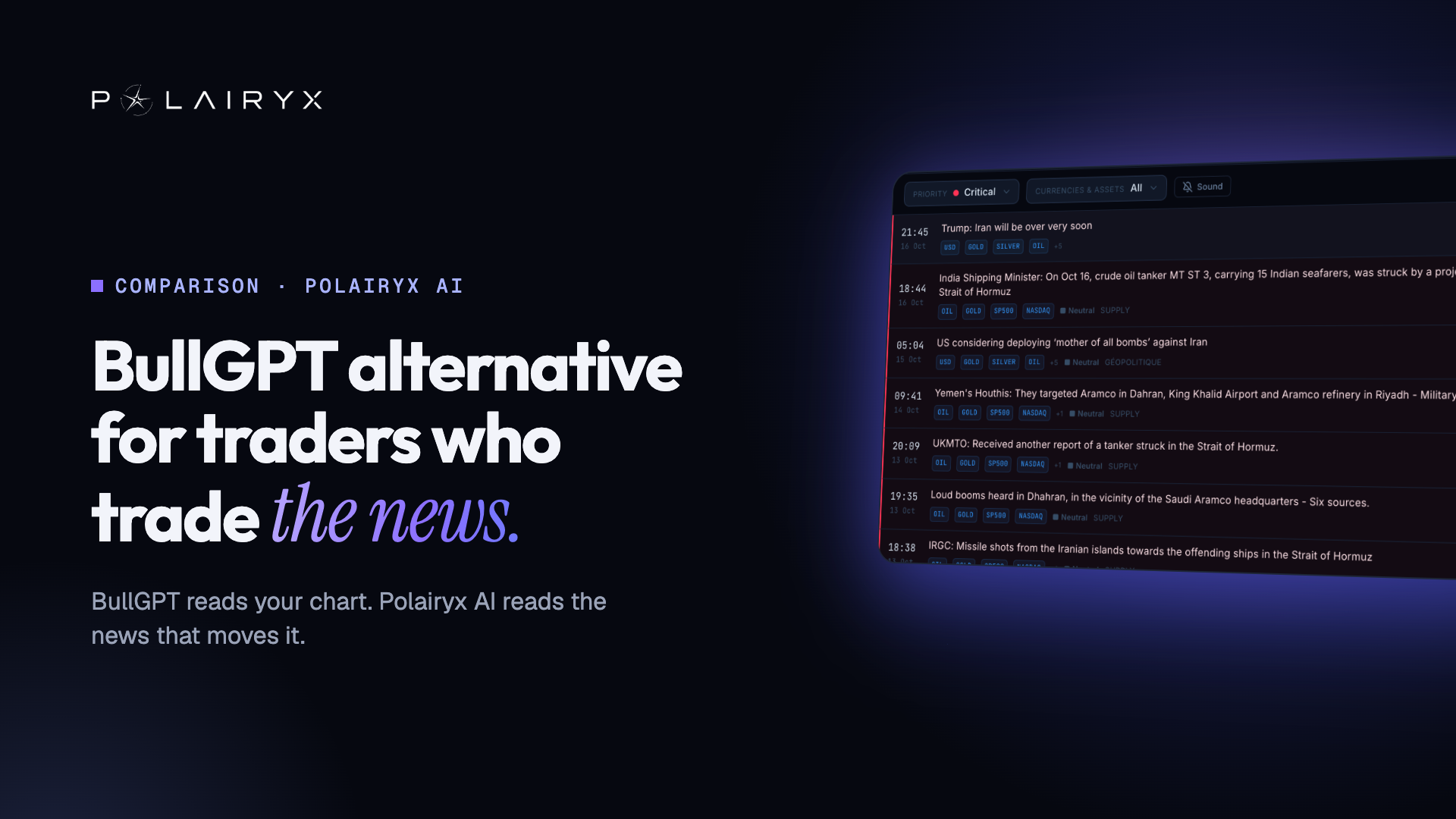
The biggest moves often happen in the minutes after a release or a headline. A US CPI print, a central bank surprise or a supply shock in oil can reprice several markets at once.
An AI news reader does three things at once:
- It reads the number against the forecast, or the headline in context.
- It tags the assets involved, for example USD, US10Y, GOLD and NASDAQ.
- It gives a direction (bullish, bearish or neutral) with a short explanation of why.
What matters is speed plus explanation. A tag without a reason is just noise. A reason that arrives ten minutes late is history.
2. Preparing the week with the economic calendar#
Most losing trades on news days share one cause: the trader didn't know the release was coming.
An AI-assisted calendar shows every release with its time, currency, forecast and previous value, highlights the high-impact ones, and explains what each one usually moves. Five minutes on Sunday evening is enough to know which days to trade lighter, and which numbers to watch.
3. Measuring positioning and expectations#
Price is only half the picture. The other half is what the market already expects:
- Positioning (COT report). The CFTC publishes every week who is long and who is short in futures markets. When large speculators are extremely long gold, for example, the trade is crowded, and crowded trades tend to reverse hardest when the news turns.
- Rate expectations. What the market prices for the next central bank meetings: hold, hike or cut, with probabilities.
- Prediction markets. Real-money odds on events such as Fed decisions or geopolitical outcomes.
AI is useful here because it reads these data sets for you and flags the extremes, instead of leaving you with raw tables.
4. Turning it all into a directional read#
The last step is the synthesis: event + context + positioning = a read on each market.
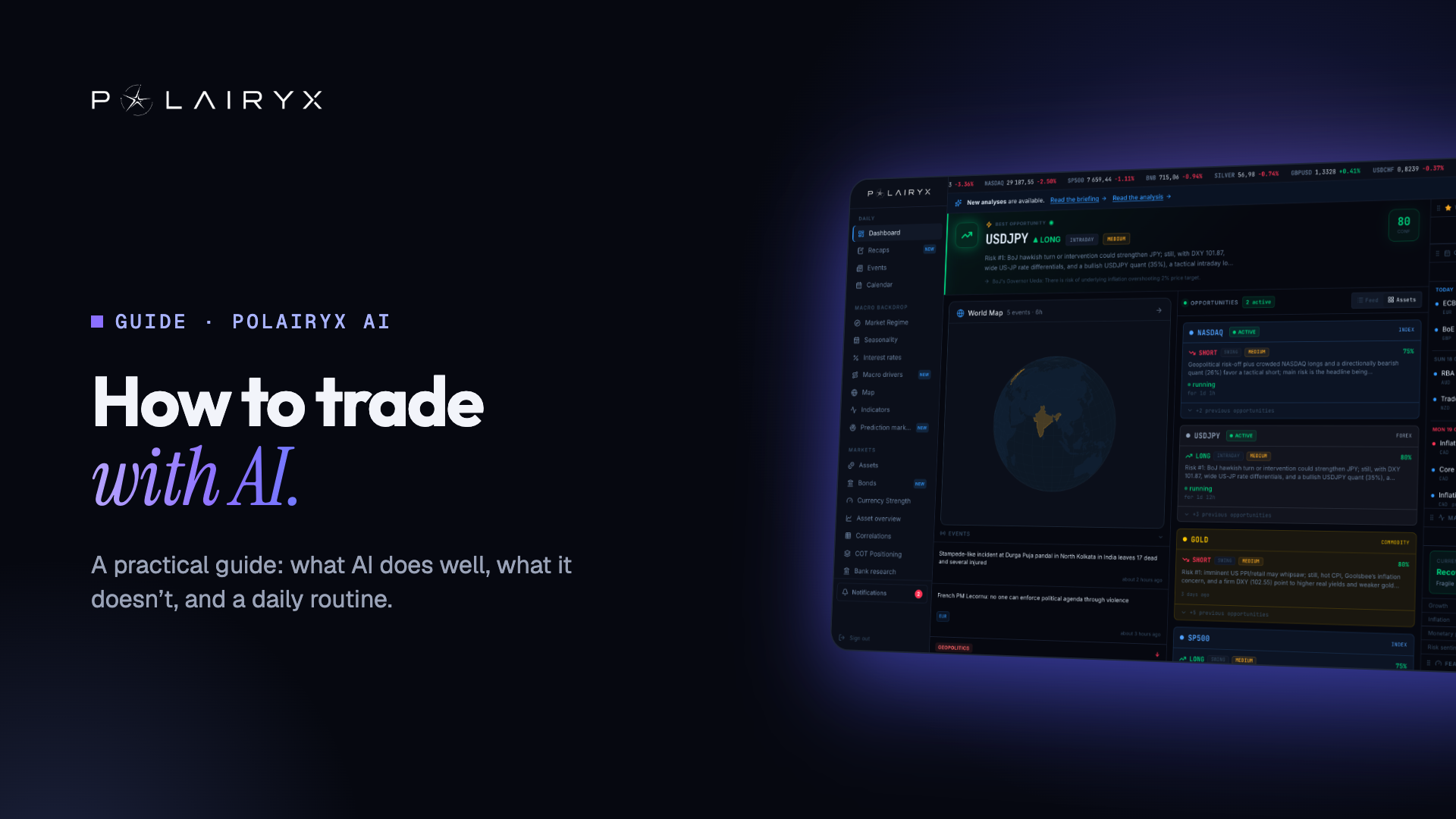
A good AI read gives you four things:
- Direction: long, short or neutral.
- Confidence: how strong the read is.
- Horizon: intraday or swing. The same shock reads differently over one hour and over one week.
- The key risk: the one thing that could invalidate the read, such as an upcoming release, crowded positioning or a headline reversal.
If a tool gives you a direction without the key risk, it's giving you half a read.
A simple AI-assisted trading routine#
Here is a routine that takes minutes, not hours:
| When | What you check | What AI does for you |
|---|---|---|
| Before the open | Overnight recap, today's releases | Summarizes what moved and why; lists today's releases with forecasts |
| At the release | The number vs the forecast | Reads it in seconds, tags the assets, gives a direction and the reasoning |
| During the session | Opportunities and key risks | Updates the read on each market as new headlines land |
| After the close | What moved, and what's next | Recaps the day and flags tomorrow's event risk |
Your job in this routine is the same as before: choose your trades, size them, and manage the risk. You just stop spending your morning across ten tabs.
Common mistakes when trading with AI#
- Following a signal without reading the reasoning. If you can't explain the trade, you can't manage it when it goes wrong.
- Treating confidence as certainty. 80% confidence still means the read can be wrong. Size accordingly.
- Ignoring the calendar. A great read can be wiped out by a release you didn't see coming.
- Over-trading because the tool updates constantly. More reads doesn't mean more trades.
- Asking a general chatbot about live markets. General chatbots are great for learning concepts, but they may not have real-time data. Always check how fresh the information is.
General chatbot vs dedicated AI trading terminal#
| General chatbot (e.g. ChatGPT) | Dedicated AI terminal | |
|---|---|---|
| Data freshness | Depends on browsing, often delayed | Live feed of headlines and releases |
| Triggered by | Your question | The event itself, automatically |
| Framework | Changes with your prompt | Same framework on every read |
| Market context | What you paste in | Calendar, positioning, rate odds, bank research |
| Best for | Learning concepts, brainstorming | Trading the news in real time |
Both have their place: one to learn, the other to trade.
Where Polairyx AI fits in#
Polairyx is an AI macro terminal built for traders who trade the news. It reads every headline and economic release in real time and tells you what it means for your market: bullish or bearish, on which assets, and why. Alongside, it gives you the economic calendar with forecasts, COT positioning, central bank rate odds, prediction markets and summaries of bank research, all on one screen.
It doesn't place trades for you. It does the reading, so you can focus on the decision. It's available in English and French, with a 7-day free trial.
FAQ#
Can AI predict the market? No tool can predict the market reliably. What AI can do is read information faster and more consistently than a human, and tell you how markets usually react to it. The decision and the risk stay yours.
Can I use ChatGPT for trading? Yes, for learning, testing ideas or understanding a concept. For live trading, check that the data is current. General chatbots are not built to follow releases and headlines in real time.
Is it legal to trade with AI? Using AI tools for analysis is legal. If you automate order execution, check your broker's terms and the rules in your country.
What is the best AI for trading the news? Look for four things: speed (seconds after the release), an explanation for every read, an economic calendar with forecasts, and context such as positioning and rate expectations. Tools that only analyze chart screenshots don't follow the news.
Does Polairyx AI place trades for me? No. Polairyx is an analysis terminal: it reads the news and macro data and gives you a directional read with its key risk. You decide whether to trade.
Polairyx provides market analysis for information purposes only. It is not investment advice. Trading involves a risk of loss.